
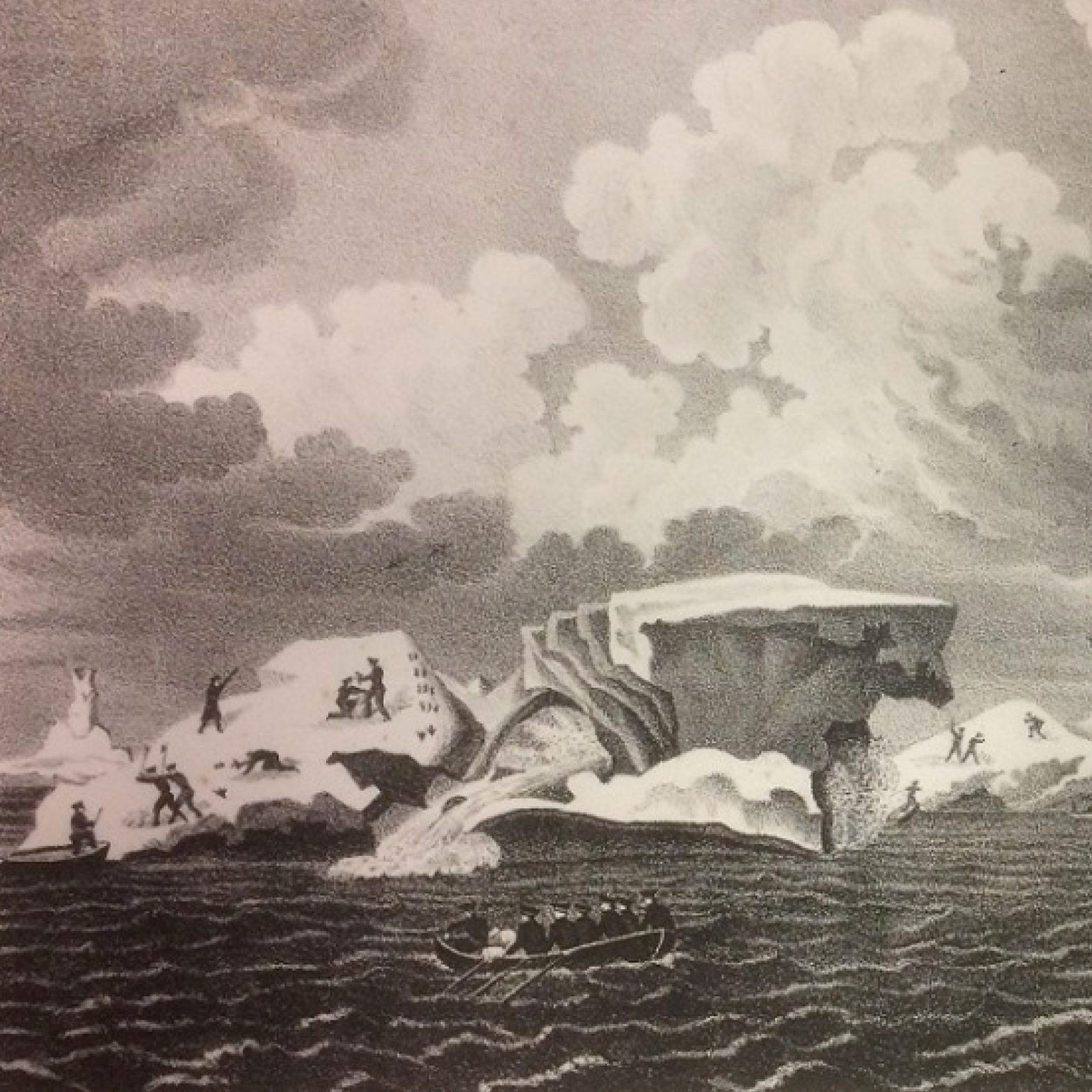
Ice islands under the fog The reports of James Eights and Jeremiah N. Reynolds about the South Shetland Islands [1830]
Article Sidebar
Main Article Content
Abstract
In January 1830, an American fleet arrived at the South Shetland Islands, consisting of the brig Annawan, Captain B. Pendleton, the brig Seraph, Captain N. Palmer, and the schooner Penguin, Captain A. Palmer, with the aim of locating and exploiting colonies of sea lions in the far south of America and to improve scientific knowledge of Antarctica. On board the Annawan were the “scientists” Jeremiah N. Reynolds and James Eights, who wrote reports on their experiences on the islands. Eights ‘report is a “natural history of the islands,” in which he reviews their climatic, geomorphological, geological, zoological, and botanical characteristics. Reynolds’ writing is, on the other hand, a “log of a segment of the voyage” in which events experienced on a daily basis by the explorers are noted and narrated. The writings are little known and we think it is pertinent to present them together as a small contribution to the history of the construction of the South Shetland Islands and Antarctica in the Western imagination.
Downloads
Article Details

This work is licensed under a Creative Commons Attribution-NonCommercial 4.0 International License.
References
Alberts, F.G. (1995). Geographic names of the Antarctic. United States Board on Geographic Names.
Anónimo (1820). Important Discovery. Imperial Magazine, 2(18), 674-676.
Bagrow, L. (1985). History of cartography. Transaction Publisher.
Bartlett, H. (1940). The Reports of the Wilkes Expedition, and the Work of the Specialists in Science. Proceedings of the American Philosophical Society, 82(5), 601-705.
Beaglehole, J.C. (1961). The journals of Captain James Cook on his voyages of discovery. Volume II, The voyage of the Resolution and Adventure, 1772-1775. Cambridge University Press
Bellinghausen, F.G. (1831). Dvukratnye izyskaniia v IUzhnom Ledovitom okeane i plavanie vorkug sveta, v prodolzhenii 1819, 20 i 21 godov. Glazunova.
Bertrand, K.J. (1971). Americans in Antarctica 1775-1948. American Geographical Society.
Bigsby, J.J. (1825). Description of a new species of Trilobite. Journal of the Academy of Natural Science of Philadelphia, 4(2), 365-368.
Bulkeley, R. (2015). Bellingshausen and the Russian Antarctic Expedition, 1819—21. Palgrave-MacMillan.
Campbell, R.J. (2000). The Discovery of the South Shetland Islands: The Voyage of Brig Williams 1819-1820 as Recorded in Contemporary Documents and the Journal of Midshipman C.W. Poynter. Hakluyt Society.
Cook, J. (1777). A voyage towards the South Pole, and round the world. Londres, W. Strahan & T. Campbell.
Davis, A.B. (1999). My year before the Mast. Hounslow Press.
Debenham, F. (1945). The voyage of Captain Bellinghausen to the Antarctic Seas, 1819-1821. Hakluyt Society.
Dickinson, A.B. (1993). Early sealing in the Falkland Islands dependencies. The Great Circle, 15(1), 1-17.
Eights, J. (1833). A Description of a new Crustaceous Animal found on the shores of the South Shetland Islands, with remarks on their Natural History. Transaction of the Albany Institute, 2, 53-69.
Eights, J. (1838). A description of the New South Shetland Island. En Fanning, E., Voyages to the South Seas, Indian and Pacific Oceans, China Sea, North-West Coast, Feejee Islands, South Shetland, & etc. (pp. 196-216) William Vermilye.
Ellis, R. (1991). Men and whales. Knopf.
Fanning, E. (1833a). Memorial of Edmund Fanning to the Honorable the Senate and House of representatives of the United States of America in Congress assembled. En Executive Documents, The House of Representatives at the First Session of the 22nd Congress at the city of Washington, December 7, 1831, Duff Green.
Fanning, E. (1833b). Voyages round the World, with selected sketches of Voyages to the South Seas, North and South Pacific Oceans, China, etc. Collins & Hannay.
Fanning, E. (1838). Voyages to the South Seas, Indian and Pacific Oceans, China Sea, North-West Coast, Feejee Islands, South Shetland, & etc. William Vermilye.
Harrison, J.P. (1955). Science and Politics: Origins and Objectives of Mid-Nineteenth Century Government Expeditions to Latin America. The Hispanic American Historical Review, 35(2), 175-202.
Howe, H. (1889). The Romantic History of Jeremiah N. Reynolds. En Historical Collections of Ohio: an Encyclopedia of State, volume 1, (pp. 431-433). Henry Howe & Sons.
Jones, A.G.E. (1975). Captain William Smith and the Discovery of New South Shetland. The Geographical Journal, 141(3), 445-461.
Lee, I. (1913). The Voyages of Captain William Smith and Others to the South Shetland. The Geographical Journal, 42(4), 365-370.
Lenz, W.E. (2021). The Poetics of the Antarctic: A Study in Nineteenth-Century American Cultural Perceptions. Routledge.
Martin, L. (1943) Early Explorations and Investigations in Southern South America and Adjacent Antarctic Waters by Mariners and Scientists from the United States of America. Proceedings of the Eighth American Scientific Congress, Vol. IX, (pp. 43-46). Printing Office of Department of State.
Mayorga, M. (2021). Loberos de Stonington en torno a las costas de Chile y Perú: entre la explotación y apropiación territorial. Revista de Estudios Marítimos y Sociales, 19, 266-301.
McKinley, D. (2005). James Eights (1788-1882), Antarctic explorer, Albany naturalist. University of the State of New York.
Miers, J. (1820) Account of the Discovery of New South Shetland, with observations on its importance in a Geographical, Commercial, and Political point of view. Edinburgh Philosophical Journal, 3(6), 367-380.
Mill, H. (1903). Bellingshausen's Antarctic Voyage. The Geographical Journal, 21(2), 150-159.
Mikhailov, P.N. (1831). Atlas k puteshestviiu kapitana Bellingauzena v IUzhnom Ledovitom okeane i vokrug sveta v prodolzhenii 1819, 1820 i 1821 godov. Glazunova
Morrell, B. (1832). A narrative of four voyages: to the South Sea, north and south Pacific Ocean, Chinese sea, Ethiopic and southern Atlantic Ocean, Indian and Antarctic Ocean; from the year 1822 to 1831. J. & J. Harper
Paterson, J. (2019). The trouble with trilobites: classification, phylogeny and the cryptogenesis problem. Geological Magazine, 157(1), 35-46.
Pearson, M. (2018). Living under their boats: a strategy for southern sealing in the nineteenth century -its history and archaeological potential. The Polar Journal, 8(1), 68-83.
Pearson, M., y Stheberg, R. (2006). Nineteenth century sealing sites on Rugged Island, South Shetland Islands. Polar Record, 42(223), 335-347.
Philbrick, N. (2004). Sea of Glory: America's Voyage of Discovery, the U.S. Exploring Expedition, 1838-1842. Penguin.
Prohaska, F. (1976). The climate of Argentina, Paraguay and Uruguay. En Schwerdtfeger, W. (Ed), Climates of Central and South America. World survey of climatology, Vol. 12 (pp. 13-112). Elsevier.
Quiroz, D. (2024). Jeremiah N. Reynolds en Chile (1830-1832). Viajes olvidados, escritos fragmentarios, conocimientos esporádicos. Biblioteca Nacional/Centro de Investigaciones Diego Barros Arana.
Reynolds, J.N. (1835). Voyage of the United State Frigate Potomac, under the command of Commodore John Downes, during the circumnavigation of the globe in the years 1831, 1832, 1833 and 1834. Harpers & Brothers.
Reynolds, J.N. (1838). Leaves from an unpublished Journal. The New York Mirror, 15, 340-341.
Sachs, A. (2007). The Humboldt Current. Nineteenth-Century Exploration and the roots of American environmentalism. Penguin.
Robinson, J. (1820). Carta de Jeremy Robinson a Samuel L. Mitchell, Presidente del Lyceum of Natural History de Nueva York, Valparaíso, 28 de enero de 1820. Columbian, 7 de septiembre de 1820.
Salerno, M.A., y Cruz, M.J. (2023). Logbooks and Antarctic sealing. Approaching early- and late- 19th-century exploitation strategies and their archaeological footprint. Polar Record, 59(e39), 1-18.
Senatore, X. (2019). Archaeologies in Antarctica from Nostalgia to Capitalism: A Review. International Journal of Historical Archaeology, 23(3), 755-771.
Silliman, B. (1820). A Journal of travels in England, Holland and Scotland and of two Passages over the Atlantic in the years 1805 and 1806, with considerable additions, principally from the original manuscripts of the author. S. Converse.
Spears, J. R (1922). Captain Nathaniel Brown Palmer. An Old-Time Sailor of the Sea. MacMillan Co.
Stackpole, E. (1955). The Voyage of the Huron and the Huntress; The American Sealers and the Discovery of the Continent of Antarctica. The Marine Historical Association.
Tammiksaar, E. (2016). The Russian Antarctic Expedition under the command of Fabian Gottlieb von Bellingshausen and its reception in Russia and the World. Polar Record, 52(5), 578-600.
Tammiksaar, E., y Lüdecke, C. (2023). The discovery of Antarctica from Ptolemy to Shackleton. En Hawkins, A. y Roberts, P. (Eds). The Cambridge History of the Polar Regions. (pp. 181-206). Cambridge University Press.
Verney, M.A. (2022) A Great and Rising Nation: Naval Exploration and Global Empire in the Early U.S. Republic. The University of Chicago Press.
Webster, W.H. (1834). Narrative of a Voyage to the Southern Atlantic Ocean, in the Years 1828, 29, 30, performed in H.M. Sloop Chanticleer, Under the Command of the late Captain Henry Foster. Richard Bentley.
Weddell, J. (1827). A voyage towards the South Pole, performed in the years 1822-24. Longman, Rees, Orme, Brown & Green.
Woodbridge III, R. (1984). J. N. Reynolds, father of American Exploration. The Princeton University Library Chronicle, 45(2), 107-121.
Young, A. (1821). Notice of the voyage of Edward Bransfield, Master of His Majesty's ship Andromache to New South Shetland. Edinburgh Philosophical Journal, 4(8), 345-348.
Zarankin, A., y Senatore, X. (2005). Archaeology in Antarctica: Nineteenth Century capitalism expansion strategies. International Journal of Historic Archaeology, 9(1), 43-56.
FUENTES DE PRENSA Y ARCHIVO
Periódicos
Baltimore Patriot (Baltimore, MD), 8 de septiembre de 1830.
Columbian (Nueva York, NY), 7 de septiembre de 1820.
Daily National Intelligencer (Washington, DC), 12 de agosto de 1834.
El Mercurio (Valparaíso), 11 de mayo de 1830, 3 de diciembre de 1832.
National Gazette & Litterary Register (Filadelfia, PA), 4 de octubre de 1828.
New Hampshire Gazette (Portsmouth, NH), 2 de diciembre de 1828.
New York Morning Courier & Enquirer (Nueva York, NY), 3 de agosto de 1831, 22 de agosto de1831, 27 de Agosto de 1831.
New-York Spectator (Nueva York, NY), 26 de octubre de 1829.
Universalist Union, Vol. III, N° 27 (Nueva York, NY), 12 de mayo de 1838.
Inéditos
Elliot, G. (1831), Journal of a sealing voyage from Stonington, Connecticut towards Cape Horn onboard the schooner Penguin, 1829-1831., Manuscripts Collection, G.W. Blunt White Library, Mystic Seaport Museum, Log 107b
Tuyll, J (1820a) Carta del Barón Tuyll al capitán Bellinghausen, Rio de Janeiro, febrero de 1820. Rossiyskiy gosudarstvennyy arkhiv Voyenno-Morskogo Flota, Fondo 25, Vol. 1, N° 114, f. 25.
Tuyll, J (1820b) Carta del Barón Tuyll al Conde Nesselrode, Ministro de Asuntos Exteriores del Imperio Ruso, Rio de Janeiro, 19 de febrero de 1820. Rossiyskiy gosudarstvennyy arkhiv Voyenno-Morskogo Flota, Fondo 25, Vol. 1, N° 114, f. 26.